Win more CRO clients by showing them the opportunity before they buy.
6to9 AI analyzes a prospect's funnel, finds conversion opportunities, and creates a working prototype — so clients see the value before signing.
The pitch problem every CRO agency has
You know what's wrong with their page. You could probably name three things from the ad that brought you to it. But the prospect doesn't buy your ability to name the problems — every competitor in their inbox names problems too, in the same tidy audit format, and they read like a template because they are one.
So the teams that win do the work up front: a real teardown, a real mock, a real before-and-after. It closes. It also takes hours of designer and developer time per prospect, which is why it only ever happens for the two or three accounts you decided were worth it. The pitch that converts best is the one you can't afford to send to most of your list.
Old way vs. new way
- Prospect asks “what can you do for us?”
- Agency commits to building an audit
- Hours spent researching the funnel
- Recommendations land in slides
- Client still wonders: will this actually work?
- Add the prospect’s website and traffic source
- AI finds the conversion opportunities
- Generate prototype changes on the real page
- Walk into the pitch showing the improvements
- Client sees the value before signing
The difference isn't speed for its own sake. It's that the last line changes: the prospect stops being asked to believe a projection and starts looking at their own page, better.
Your AI CRO analyst, for winning and delivering client work
6to9 works the way a junior strategist would, if you could give one to everybody on your team. Point it at a prospect's site and a traffic source. It reads the funnel, finds where that traffic is leaking, and builds a working prototype of the fix on the real page — not a mockup, not a staging clone, the page itself as it loads in a browser.
Then your expert takes over. That order is the whole point: the research and the first draft are the hours you were giving away, and the judgment about what's worth doing is what clients are actually paying for.
- 1
Pick the page with a ton of traffic
Start where their money already is — the page their ads point at, or the one search sends them. High traffic is what makes the conversion argument worth having, and it's the page they already know is expensive.
- 2
Let the AI make the basic fixes — the easy stuff — right on the real page
The obvious wins get applied to their actual page: the headline that doesn't match the ad, the buried CTA, the proof that isn't there. This is the research pass you used to spend a strategist's afternoon on.
- 3
Add, change, or remove anything on the page
Then put your expertise on top. Describe the change in plain language, or take hold of the element and adjust it by hand. This is what makes it your teardown rather than a generated one — and it's the part worth paying for.
- 4
Save it. Share it with anyone.
The version you built becomes a link. No account needed on their end, nothing to install, nothing to schedule.
- 5
Send the link — they see the changes live
They open their own page and it's better. Not a rendering of their page, not a screenshot with arrows on it — the page, with your work on it, in their browser.
- 6
Export a slick PDF pitch to send your customer
The link wins the meeting; the PDF survives being forwarded. It's what gets opened by the person who approves the budget and wasn't on the call.
Six we already generated
These are real, and they open. Each one was built from nothing but a domain and a traffic source — the same two inputs you'd have for any name on your list, before a single conversation.
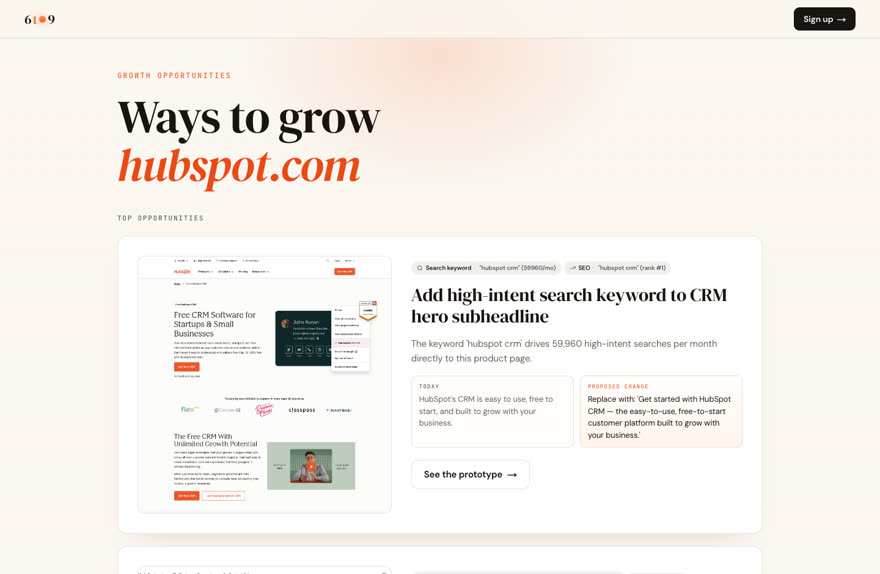
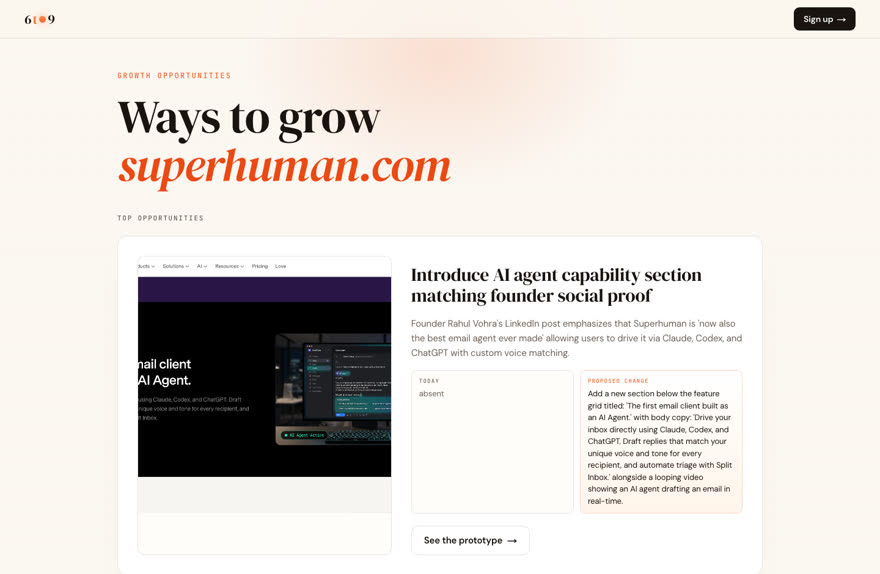
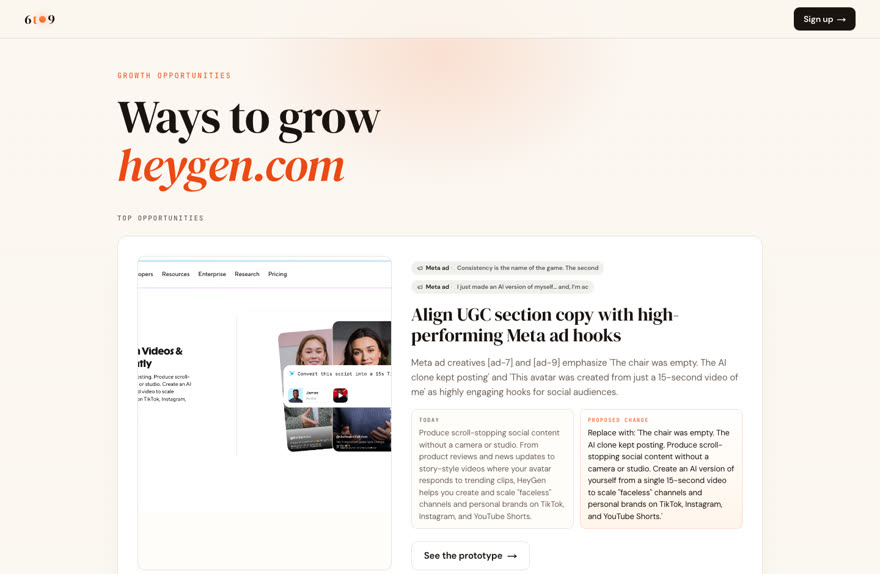
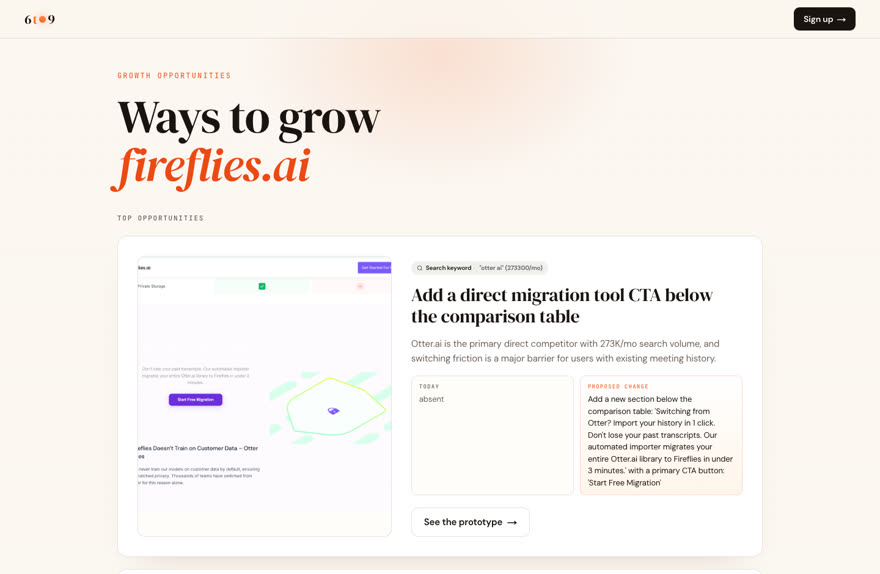
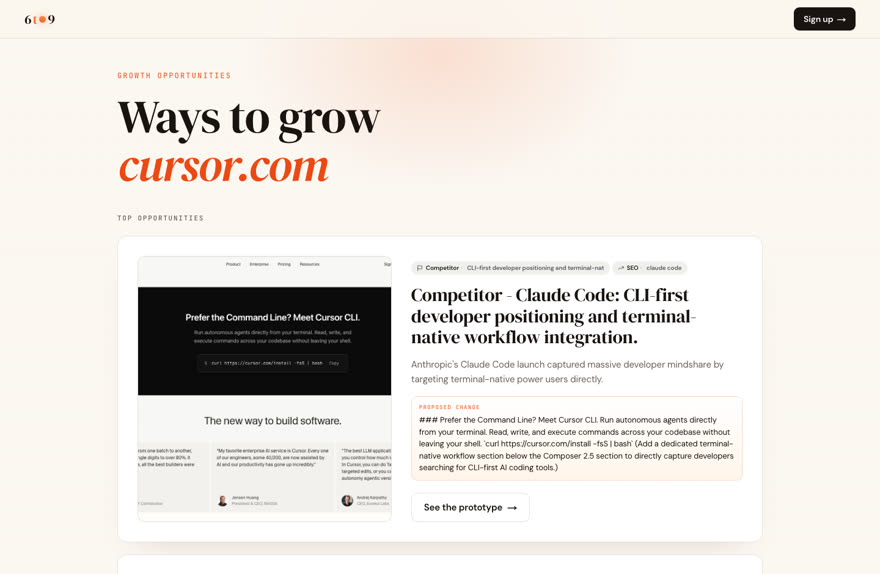
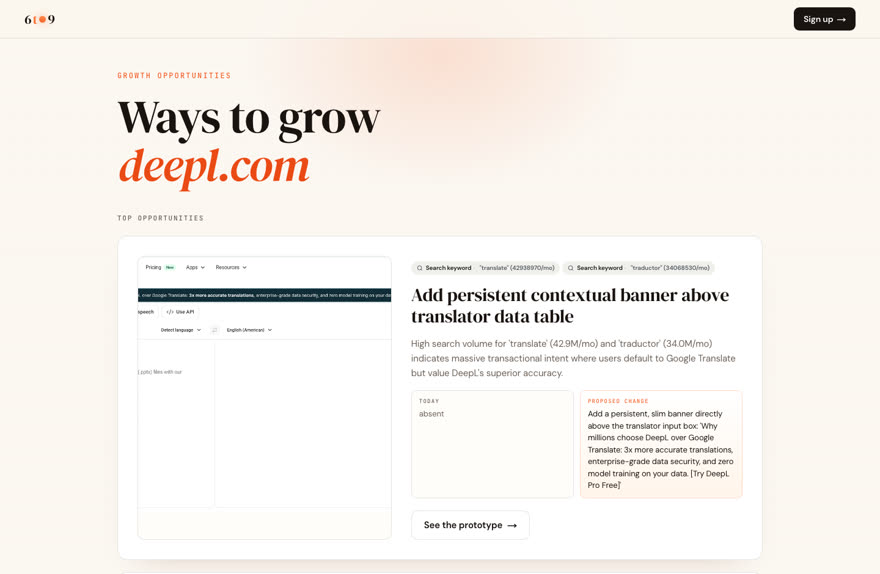
Open any of them and look at what a prospect would be looking at: the opportunity named, the search volume behind it, the current copy next to the proposed copy, and a prototype of the change on the live page. That's the artifact — and none of these companies has spoken to us. That's the point. It's what you can put in front of someone before they've agreed to a call.
What it changes about the way you sell
Win more pitches
Show prospects real improvements to their own site instead of generic recommendations they've already read in three other proposals.
Reduce free consulting
Create detailed teardowns in minutes, not hours — so the deep pitch stops being something you ration to your top accounts.
Scale your experts
Give every strategist an AI analyst working alongside them, so your senior judgment reaches more accounts without more headcount.
Built for CRO experts. Not to replace them.
Your team's experience is the advantage. 6to9 AI handles the research and the first drafts so your experts spend more time deciding what matters.
That's the honest division of labour. A model can spot a headline that doesn't match the ad that paid for the click, and it can apply the fix to the page faster than a person can open the file. What it can't do is know that this client's real problem is a pricing page contradicting their sales motion, or that the obvious fix will be killed by their legal team. That judgment is why they're hiring you — and it's the part of the work that stops getting crowded out by the research grind.
The teams getting the most out of this aren't automating their CRO thinking. They're the ones who stopped spending Tuesday on the funnel spreadsheet.
Two things worth knowing before you send one. The prototype lives on top of the page as it loads, so it demonstrates how the page looks and reads — not how a calculated price or a form submission behaves. For landing pages that distinction rarely matters, but be clear which you're showing. And a page behind a login needs whoever opens the link to have their own access to it, which is another reason the public landing page is usually the right one to pitch on.
What's different a quarter in
The first thing to move is reply rate, because "here's your page, improved" is a subject line with something behind it.
The second is what happens on the call. You arrive with a prototype the prospect has already opened and reacted to, so the conversation starts at scope and price rather than at whether you understand their funnel. Discovery stops being a phase you give away and becomes something you've visibly already done.
The third shows up in the P&L. When the deep pitch costs minutes instead of a strategist's day, you stop choosing which prospects deserve one. The whole list gets the version only your top three used to get, and the constraint moves back where it belongs: whether those are the right names.
Take the prospect you most want to land and open their highest-traffic page. The pitch is the page.
Frequently asked
Doesn't AI miss the judgment that makes CRO work?
It would, if you let it decide. That's not the split. The AI does the research pass and the first draft — pulling the traffic picture, flagging the obvious conversion problems, and applying the easy fixes to the real page. Your strategist decides which of those actually matter for this client, throws out the ones that don't, and adds the insight no model was going to have. The output is your thinking, arrived at faster.
How is this different from the audit we already do?
An audit describes the opportunity. This shows it working on their page. The prospect stops evaluating whether your recommendations sound right and starts looking at their own site, improved — which is a much shorter distance to a yes.
Do I need the prospect's permission?
Not to build it. You're working on their public page in your own browser, the way any visitor loads it — nothing is added to their site and nothing about it changes. What matters is the framing: send it as a proposal, and be clear it's your version rather than something live on their site. That's also the more persuasive framing — the point is that you did the work, not that you got access.
Does this touch the prospect's real website?
No. The changes are applied on top of the page as it loads in a browser. Their production site is untouched, their visitors see no difference, and the only people who see your version are the ones you send the link to.
Does my team need to write code or design?
No. Changes are described in plain language, or made by taking hold of an element and adjusting it directly. That's what lets a strategist build the teardown without booking your designer — which is the whole reason it can happen for the full list instead of the top three.
What happens after they sign?
The teardown you pitched becomes the roadmap you deliver. You start the engagement with an agreed change on a real page instead of a discovery phase spent establishing what to look at — and the same tool your team used to win the account is the one they use to do the work.
Published July 30, 2026 · updated July 31, 2026
Test it on your next CRO pitch.
Take one prospect you're already chasing, build the teardown, and see what it does to the call.
New to 6to9? See how it works in four steps.