How to do competitor analysis as a solo founder
The company worth copying isn't the biggest one in your category. It's the one that shares your constraints — and that's a different list.
What is competitor analysis for a solo founder?
It's working out which companies' results are actually evidence for your decisions — and then reading only those. For a one-person company that's a much shorter list than the category leaderboard, because most of what a large competitor does now depends on things you don't have: a brand, a sales team, a budget, an audience that already shows up.
6to9 is a growth tool for founders that produces this as a monthly report: it takes your product, finds the companies that share its structural traits, and turns what worked for them into an ordered list of moves for you — each one carrying the company it came from and how strong that evidence is.
The problem with studying the biggest company in your category
You open a doc. You list five competitors, everyone you've heard of. You fill in columns — pricing, features, positioning, what their homepage says. Two hours later you have a tidy grid and no idea what to do on Monday.
The grid isn't wrong. It's just answering a question you didn't have. You already knew roughly what those companies sell. What you needed was a decision about where your next two weeks go, and a feature matrix has no opinion about that. Worse, the companies on it are usually the famous ones, and famous companies are the least transferable: the move that worked for them worked because they were already big when they made it. Their playbook assumes their starting conditions.
Copy the companies shaped like you, not the ones ahead of you
The useful filter isn't "who competes with me." It's "whose result would still hold if I did the same thing with the resources I actually have."
That points at a different set of companies — sometimes not competitors at all. Two products can sell to the same buyer and be structurally unrelated, and two products in different categories can be near-identical in the only way that matters: how a stranger finds them, what has to be true for them to convert, and what the founder can build alone.
We call the ones that pass the filter closest twins. A twin has to share at least two of your product's hard traits — the unusual, load-bearing properties that determine which growth moves are available to you at all. Anything sharing fewer than two is still allowed in, but it gets marked as directional evidence rather than proof, because that's what it is.
This is the part that decides whether the whole exercise is useful, and it's the part that's usually skipped. "Who are your competitors" gets answered from memory, which returns the best-known names. Those are selected for being famous, not for being informative — which is exactly backwards from what you want.
Two we already generated
These are real reports, and they open. The first is the one we ran on ourselves, which is the fairer thing to show you.
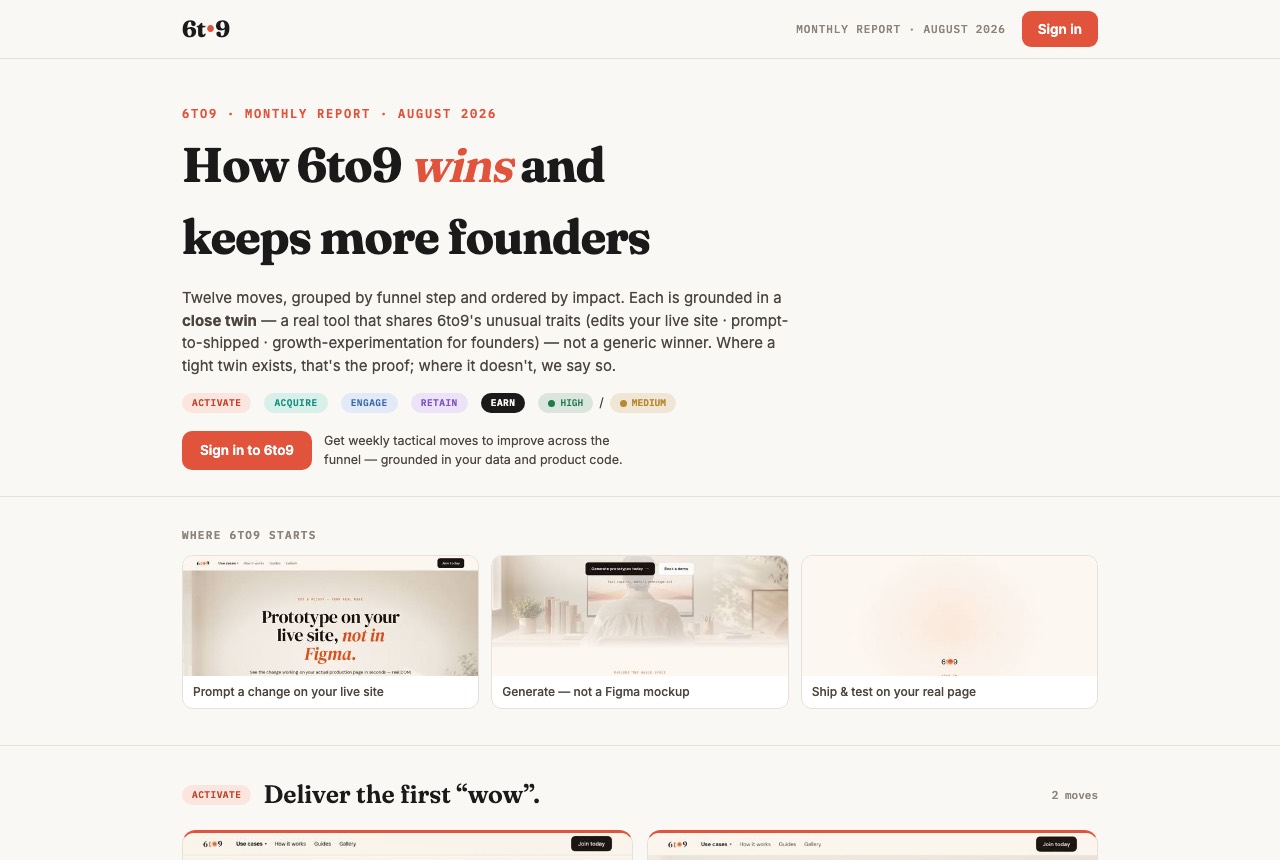
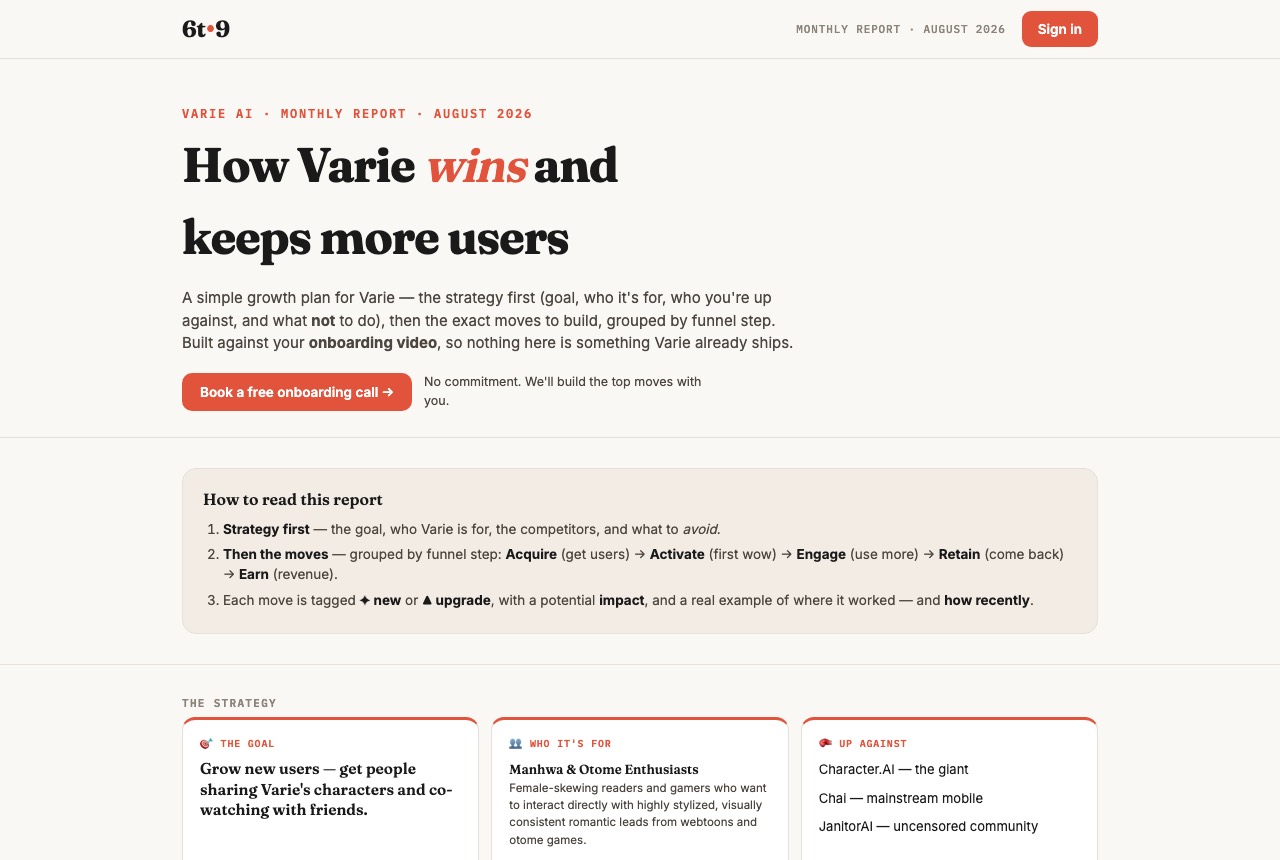
Open ours and you can check the reasoning yourself. Twelve moves, grouped Activate → Acquire → Engage → Retain → Earn and ordered by impact. Each names the company it was borrowed from, what trait we share with them, a rough build estimate, and what actually moved for them. The evidence table at the bottom lists every twin with its shared traits and a source link, and marks each claim stated, estimated or anecdotal.
Some of it is uncomfortable to publish, which is the point of publishing it.
How to do it
- 1
Write down your three hard traits
Not your features — the properties that constrain how you can grow. Ours are: it edits your live site, it goes from prompt to shipped, and it's growth experimentation aimed at founders. Yours might be a zero-touch signup, a two-sided market, or a product only usable at a specific moment. Three is enough. These are the filter for everything that follows.
- 2
Find companies sharing two of them, ignoring category
Deliberately look outside your competitive set. The point of the two-of-three rule is that it lets in a company with your shape and keeps out one with your customer but a different engine. If your list is all direct competitors, you filtered by category again out of habit.
- 3
For each one, find the specific thing that moved a number
Not their strategy. One move, and what it did — a free tier, a badge on the artifact, a hackathon, a template library. If you can't find what it changed, you have a story rather than evidence, and it should be labelled that way when you use it.
- 4
Check each move against what you already ship
This is the step that separates a real report from a generated one. Half of a generic recommendation list is things you did months ago, and every one of those costs you trust in the rest of the list. Our reports are built against the product as it currently exists, so what you've already got doesn't come back as advice.
- 5
Order them by funnel step, not by excitement
Sorting into Acquire → Activate → Engage → Retain → Earn shows you the gap. Most solo founders have six acquisition ideas and nothing for the week after signup, and the ordering makes that visible in a way a ranked list never does.
- 6
Write the 'do not build' list, and take it seriously
Name the territory a bigger competitor genuinely owns and rule it out on purpose. Ours says: no full-stack hosting, that's Bolt's; no enterprise CMS, that's Optimizely's; no heavy design canvas, that's Framer's. A solo founder's scarcest resource is attention, and this is the only part of the exercise that gives some back.
What separates a useful report from a generated one
Three things, and they're all about restraint rather than coverage.
| The usual output | What to demand instead | |
|---|---|---|
| Who it compares you to | The best-known names in your category | Companies sharing two or more of your structural traits, whatever category they're in |
| What it recommends | Best practices that apply to anyone | Specific moves a twin actually made, with what changed as a result |
| How sure it is | One confident voice throughout | Per-claim labels — stated, estimated, anecdotal — and a visible split between close twins and directional analogies |
| How recent the proof is | Undated, so a 2019 tactic reads like a 2026 one | A date on every example, because channel economics expire |
| What it says about your product | Suggests things you already shipped | Checked against your current product, so shipped work doesn't come back as advice |
| Where it stops | An unbounded list of opportunities | An explicit do-not-build list naming whose turf each one is |
The middle row is the one to hold out for. A report with no confidence markings is a report that will be wrong somewhere and won't tell you where, and you'll find out by building the wrong thing.
"Isn't this just going to tell me to copy people?"
Fair, and the honest answer is: partly, on purpose.
Original growth ideas are rare and expensive to validate alone. Most of what works for a one-person company is a known move applied to a situation it hasn't been applied to yet, and the value of knowing a twin already ran it is that you're spending your two weeks on execution risk instead of on whether the idea works at all.
Where it stops being copying is the two constraints on it. The twin has to share your shape, so the move has to be available to you as you are. And the do-not-build list explicitly rules out the ground where copying would be suicide — the places a bigger company's version will always beat yours because it's their core product and merely your feature.
What's different a month later
The change isn't that you get more ideas. It's that the ideas arrive already sorted, with their evidence attached, so the decision takes ten minutes instead of a week — and the ones that were never available to you never enter the list.
If the next question is what to actually say on the page once you've picked a move, how to find your marketing angle from what's already working covers the other half: reading demand from the content people already engage with. And if you want to hand the whole thing to a coding agent rather than work through it yourself, how to give Claude Code the context to prioritise your roadmap is the sequel to this one.
Frequently asked
How do you pick which competitors matter?
By shared constraints rather than shared category. We look for companies with at least two of your product's structurally unusual traits — the things that determine what growth moves are even available to you. A company that sells the same thing but reaches customers a completely different way is a competitor commercially and useless as evidence. A company in a different category that grew the same way you'd have to grow is the opposite.
What if my competitors are much bigger than me?
Then most of what they do now is unusable, and the report should say so rather than dress it up. What's still usable is what they did at your stage, which is usually a much smaller and stranger set of moves than their current playbook. The other genuinely useful thing a big competitor gives you is territory to avoid — the report ends on exactly that, naming what not to build because someone else already owns it.
Won't an AI just make up plausible-sounding competitor facts?
That's the real failure mode, and it's why every number in the report carries a confidence label — stated, estimated, or anecdotal — next to the source it came from. A move backed by a company sharing two or more of your traits is marked as a close twin; one backed only by a loose analogy is marked as directional and nothing more. You can disagree with a recommendation, but you can always see what it rests on.
How is this different from asking ChatGPT to analyse my competitors?
A chat answer is built from what the model remembers about your category and it will name the famous companies, because those are the ones written about most. The difference here is the selection rule and the grounding: the twin set is chosen by shared traits, the recommendations are checked against what your product already does so it doesn't suggest what you shipped last month, and the evidence is labelled. The failure mode of a chat answer is that it's confident and generic; both halves of that are the problem.
Do I need to give you access to my product or my analytics?
No. A domain is enough to start, and the report is built from what's publicly observable about your product plus public reporting on the companies it compares you to. Connecting more of your own data makes the recommendations sharper, but the first report doesn't wait on it.
Is one report enough, or is this a recurring thing?
It's built to recur monthly, because the useful question changes as you ship. The first report is mostly about position — who you're actually shaped like and what territory to stay out of. Later ones are mostly about sequence, since the moves you've already made take themselves off the list.
Published August 27, 2026
See what your closest twins already proved.
One domain in. A funnel-ordered set of moves out, each one grounded in a company shaped like yours — and marked with how good the evidence actually is.
New to 6to9? See how it works in four steps.