How to find your marketing angle from what's already working
The language that works in your category is already out there, in videos people chose to watch. You don't have to invent an angle. You have to notice one.
How do you find a marketing angle without guessing?
You read what people in your category already engage with voluntarily, and you look for what repeats. The angle is almost never a new idea — it's a want that shows up over and over in content nobody was paid to watch, phrased in the words the audience uses rather than the words you use internally.
6to9 does this as a report: it searches your category across short-form video and ad libraries, keeps only what's genuinely relevant, groups it into the handful of stories that actually recur, and then builds each one into a landing page on your real content so you can run it.
Why your homepage headline is probably a guess
Most founders write their headline from the inside. You know what the product does, you know why you built it, and the sentence that comes out describes the mechanism — the thing you're proud of, which is usually the thing the customer cares least about.
The alternative isn't inspiration. Somewhere on the internet there are people talking about the problem you solve, in their own words, without a marketing brief, and the ones who found the right words got watched a lot more than the ones who didn't. That's a running experiment with public results. The work is reading it properly.
The distinction that makes this work: organic content, not just ads
A competitor's ad tells you what they were willing to spend money to say. That's useful, but it's a claim about their strategy, not about their customer — plenty of well-funded companies buy a lot of impressions for a message that isn't landing.
Organic video is a stronger signal, because nothing pushed it. Someone made it, and strangers chose to watch it through. When four different creators independently reach for the same framing and the audience rewards all four, you've learned something about demand that no amount of competitor teardown gives you.
The trade-off is sample size, and any report that hides this is selling you something. On the run below, eight searches returned sixty-four videos and eleven survived the relevance filter — four stories built on eleven videos. That's enough to decide what to test next. It is not enough to conclude anything, and the output should be read as a testing queue rather than a finding.
When the absence is the finding
The most useful result on the example run was a channel that was empty.
We checked both TikTok and Meta for an AI-companion app. TikTok was busy. Meta and Instagram were nearly silent — the direct competitors were running almost no ads there. The obvious read is "Meta doesn't work for this category," and it would have been wrong. The reason was a platform restriction on AI-companion advertising, which means the silence wasn't a verdict about demand at all.
That reframes the whole channel. A restricted category still has adjacent players advertising freely — in this case avatar-video tools selling prerecorded content — so the ground where a live companion could be positioned was sitting unclaimed on both channels. That's not a conclusion you can reach by studying what competitors are doing. It only appears when you also record what nobody is doing, and then ask why.
The general form: an empty channel is only a finding once you know the reason it's empty. A tool that reports the emptiness without the reason has handed you a coin flip.
One we already generated
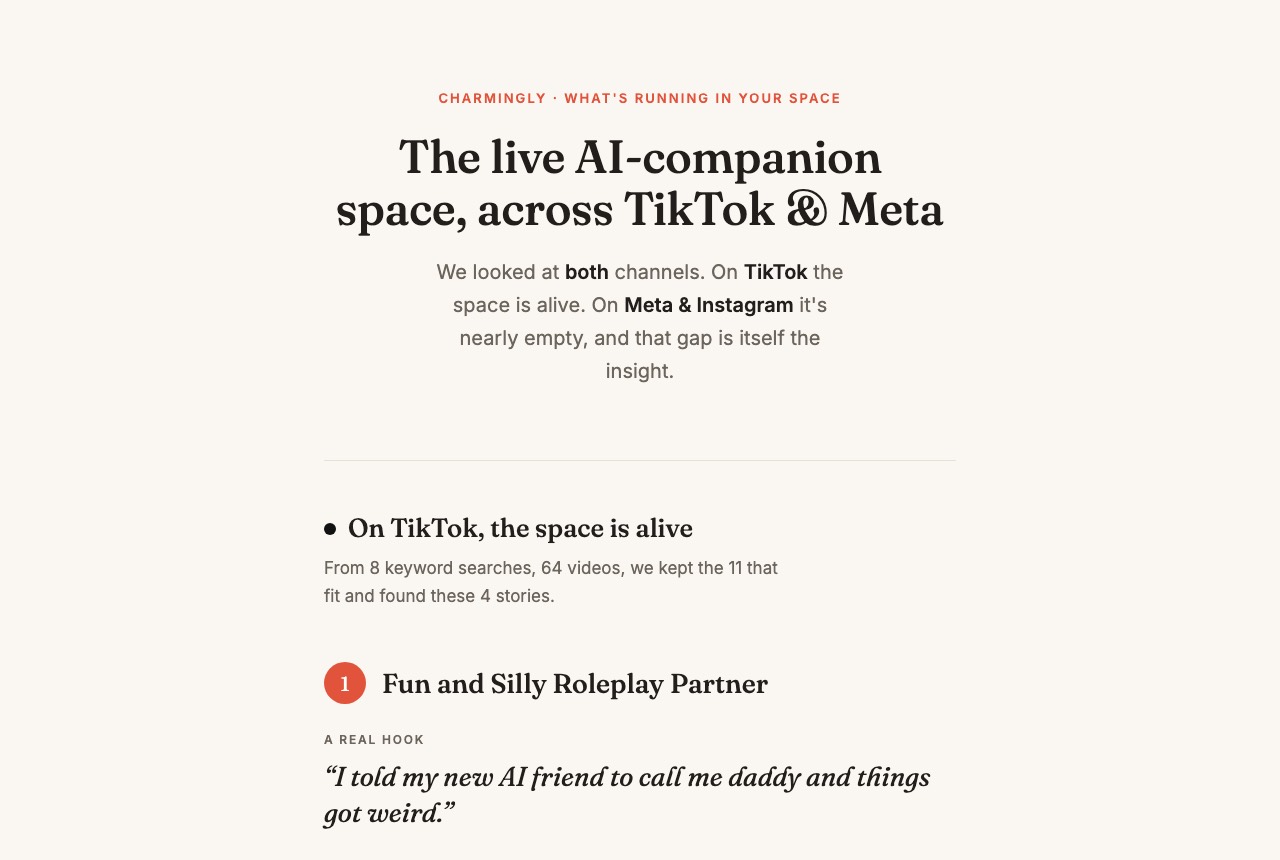
Four stories, each with the hook line that actually appeared, what it means in plain words, why the audience responds to it, and the videos it came from with their view counts. Then the Meta half and why it's empty. Then three landing pages built on the product's real content, one per angle, ready to open.
How to do it yourself
- 1
Search the problem, not your product name
Nobody making content about your category knows your product exists. Search the words a person uses to describe the situation before they've found a solution — the symptom, the frustration, the moment it happens. Product-name searches return your own marketing back to you.
- 2
Throw most of it away
Expect a low keep rate; the example run kept eleven of sixty-four. A video that mentions your category in passing is noise, and including it to make the sample look bigger is how you end up with a story that isn't there. Relevance is the whole job.
- 3
Group into stories, not keywords
Cluster by the want underneath, not by phrasing. Four videos saying 'lonely at night', 'nobody to talk to', 'my friends are asleep' and 'just want someone there' are one story, and it's the story you'd write a page about — not four keywords you'd bid on.
- 4
Take the hook verbatim
Keep the exact sentence that opened the video that performed. Your rewrite will be cleaner and it will convert worse, because the original was selected by an audience and yours was selected by you. Edit it after you've tested it.
- 5
Check the channel where nobody is
Look at where your category isn't advertising and find out why. Restricted, wrong audience, or simply untried are three completely different answers, and only the last one is an opportunity.
- 6
Turn each story into a page and run it
An angle you haven't tested is a preference. Build one page per story on your real content, send traffic, and let them compete — the value of having four is that you find out which want is strongest, which no amount of reading gets you.
The objection: "this is just copying what's trending"
Trend-chasing is copying the form — the sound, the edit, the format that's hot this month. That decays fast and it's not what's on offer here.
What you're extracting is the underlying want and the language it's expressed in, and wants move much more slowly than formats. "I don't want to be alone at 1am" isn't a trend. The video style that carried it will be dated in six months; the want won't be.
The other guard is that the output goes to a test rather than to production. You're not being told to rewrite your homepage because a video did well. You're being handed four candidate pages and the traffic decides.
What's different a month later
The compounding part isn't the first report. It's that once the angle question becomes something you test rather than something you argue about, the next one takes an afternoon.
If you haven't yet decided which competitors are worth reading in the first place, how to do competitor analysis as a solo founder covers the selection rule — it matters more than the analysis. And if you'd rather hand the raw findings to a coding agent than work through them by hand, how to give Claude Code the context to prioritise your roadmap picks up there.
Frequently asked
Is this analysing my competitors' ads?
Partly, and the smaller part. Most of the signal comes from organic content — videos people chose to watch and engage with, which is a better demand signal than an ad, because an ad only tells you what someone was willing to pay to say. We do read the ad side too, and sometimes the more useful finding is that a channel is empty. On one run in the AI-companion category, the direct competitors were running almost nothing on Meta; the reason turned out to be a platform restriction, which made an unclaimed positioning visible that the founder hadn't considered.
How many videos does it actually look at?
On the example run: eight keyword searches returning sixty-four videos, of which eleven were judged relevant enough to keep, grouped into four repeating stories. The filtering ratio is the point — most of what a keyword search returns is off-topic or unrelated to the product, and a tool that reported all sixty-four as findings would be padding. It also means the sample behind each story is small, so treat the output as a set of things to test rather than a conclusion.
What if my category has no TikTok presence at all?
Then that's the result, and it's worth knowing before you spend a month producing videos for it. An empty channel is a real finding in two directions: it can mean your buyers aren't there, or it can mean the position is unclaimed. Which one it is depends on why it's empty — a platform restriction, a buyer who lives elsewhere, or simply nobody having tried yet. The report should tell you which, and if it can't, it shouldn't guess.
Does it only cover TikTok and Meta?
Those are the two it reads today. They were first because they're where short-form demand signal is densest and where ad libraries are public enough to check. More channels are the obvious direction, but the article you're reading describes what runs now.
Won't I just end up sounding like everyone else?
That's a real risk if you copy the phrasing, and the opposite of what the output is for. What repeats across a category is the underlying want, not the wording — 'someone to talk to tonight' is a need, and there are twenty ways to say it. The differentiated move is usually to take a want everyone has confirmed and say it in a register nobody in the category uses.
What do I do with the output?
Test it. Each story comes with a page built to match it, on your real content, so the gap between the insight and something a visitor can land on is a click rather than a sprint. Run the ones you believe, and treat the rest as evidence you haven't spent anything on yet.
Published August 27, 2026
Find out what's already working in your space.
We read both the organic content and the ads in your category, group what we find into the few stories that actually repeat, and turn each one into a page you can test.
New to 6to9? See how it works in four steps.